




Discover the best markets for fresh, healthy and quality products in Andalucia


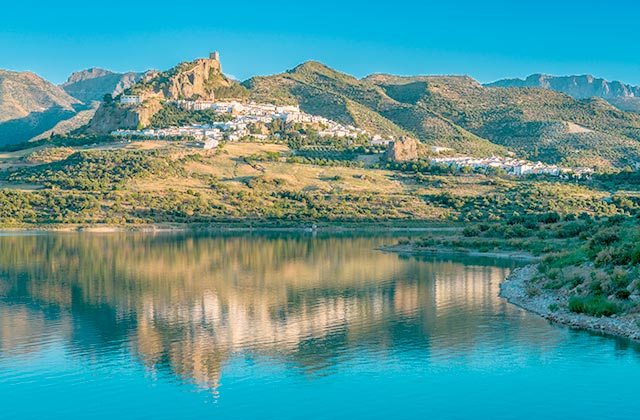
Andalucia is a region with a wide variety of landscapes, ranging from the Mediterranean coast to the Sierra Nevada mountains. This natural diversity has created numerous rivers, springs, reservoirs, pools and intertidal rock pools, some of which are truly spectacular. When summer arrives and temperatures traditionally rise across the region, there is nothing quite like discovering lakes, pools, reservoirs and inland beaches where you can cool off.
Many of these places are surrounded by vegetation and provide the perfect setting for enjoying the sunshine and tranquillity of summer. They include some of Malaga’s best-known natural spots, such as the Ardales reservoirs and Cueva del Gato in Benaoján.
Hidden away in the heart of Andalucia are landscapes that seem almost otherworldly. Here is our selection of natural attractions that offer an alternative to the beach during the summer months.
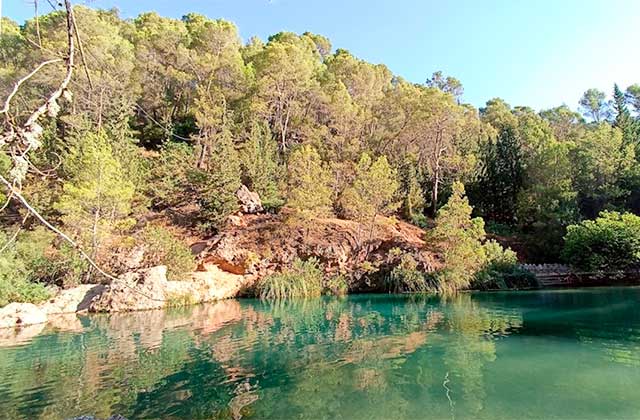
Charco de la Pringue, also known as Charco del Aceite, is a natural pool in the course of the River Guadalquivir, between the municipalities of Villanueva del Arzobispo and Sorihuela del Guadalimar. Surrounded by pine trees, the pool has been developed as a recreational area. According to local tradition, its name comes from a donkey that fell into the river while carrying oil.
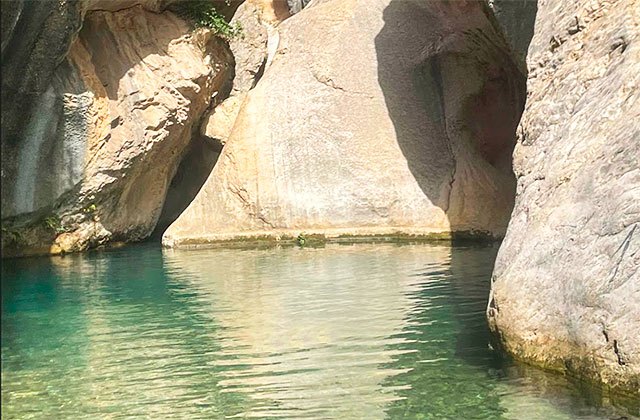
Just 10 kilometres from Jaen, near Puente de la Sierra, Los Cañones is a beautiful gorge carved out over time by the River Eliche. It has long been one of the favourite recreational areas among local residents and is known for its scenery and the walking routes through the surrounding countryside.
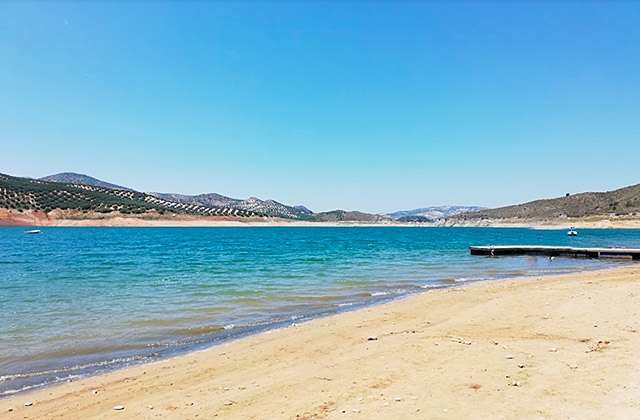
Valdearenas Beach is an inland beach on the Iznájar Reservoir, right in the heart of Andalucia. Its sand is fine and golden, and the surrounding area offers activities such as fishing, canoeing and hiking.
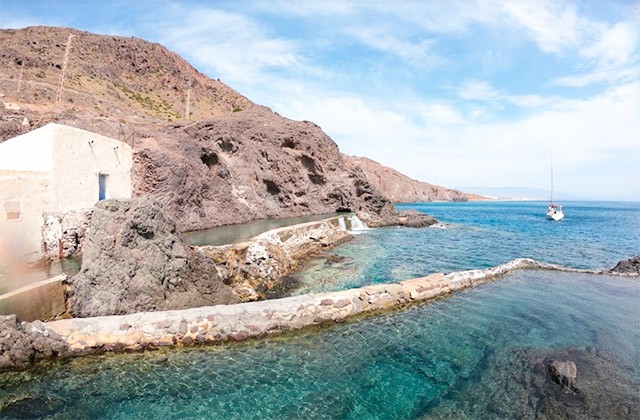
The locks at the Cabo de Gata-Níjar salt pans form part of the hydraulic infrastructure used to channel and distribute seawater through the salt ponds. They are not natural pools created by evaporation, nor are they intended for swimming or diving. Their appeal lies in the striking salt-pan landscape and the natural richness of the Cabo de Gata-Níjar Natural Park.
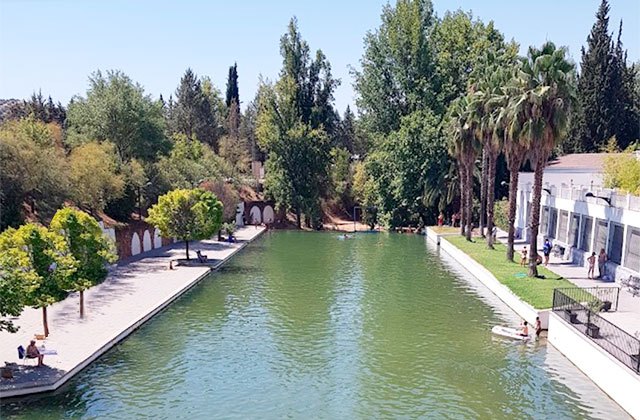
The Mogón natural pool is one of the best known in the province of Jaen. It is located on the River Aguascebas, shortly before it flows into the Guadalquivir, in the heart of the Sierras de Cazorla, Segura y Las Villas Natural Park. The surrounding area is ideal for activities such as hiking and wildlife watching.
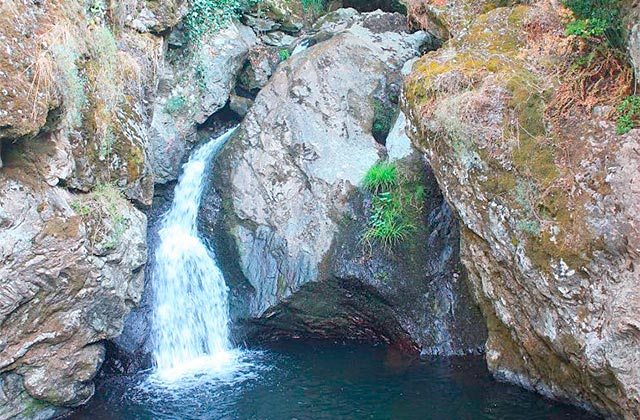
The pools of Barranco de la Guijarra are located in the Sierra de Aracena y Picos de Aroche Natural Park, near Cortelazor. The area is known for Charco Malo and for a walking route surrounded by lush vegetation.
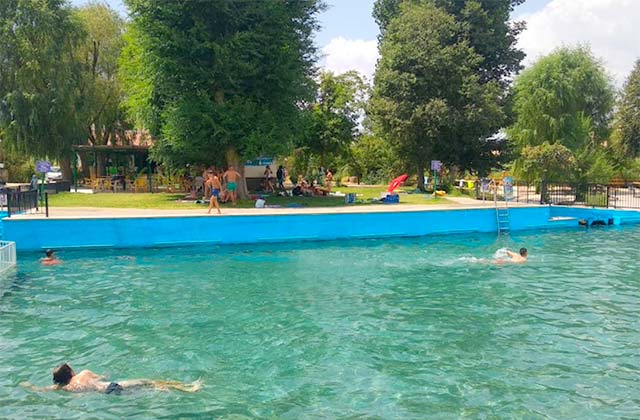
One of Granada’s most attractive natural pools can be found near the town of Huéscar, the capital of the district of the same name.
Huéscar enjoys a beautiful setting beside the Sierra de la Encantada and on the banks of the River Barbatas, close to places such as the San Clemente Reservoir and Rodríguez Penalva Park.
As well as its wonderful natural surroundings, the town has a rich historical heritage, including the Collegiate Church of Santa María la Mayor, the Cantera de San Valentín Tower and the Ánimas Bridge. Its traditional architecture, particularly its cave houses, is also well worth discovering.
On the outskirts of the town, residents and visitors can enjoy a wonderful natural pool formed by the Fuencaliente spring. Its water remains at around 18°C throughout the year, and a grassy area has been created along the shore for comfortable sunbathing.
A large recreational area has been developed around the pool, with sports facilities, parking and places to eat.
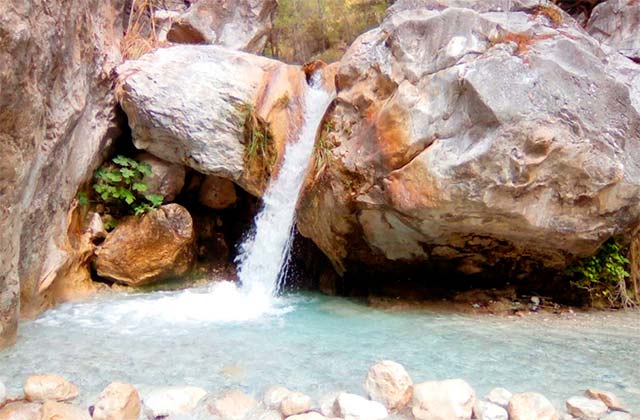
One of Malaga’s natural pools can be found in one of the Costa del Sol’s most popular tourist destinations, a town famous for its beautiful beaches: Nerja.
Nerja is one of the most visited destinations on the Malaga coast. Its 14 kilometres of coastline are renowned for attractive beaches such as La Caletilla and El Chorrillo.
What many people do not know is that the River Chíllar also flows through the municipality of Nerja, surrounded by a landscape of remarkable natural beauty.
Near Nerja, the river forms impressive gorges known as Los Cahorros, where the channel narrows between steep rock walls. Further along lies the well-known Poza de los Patos, surrounded by vegetation and beside a small waterfall.
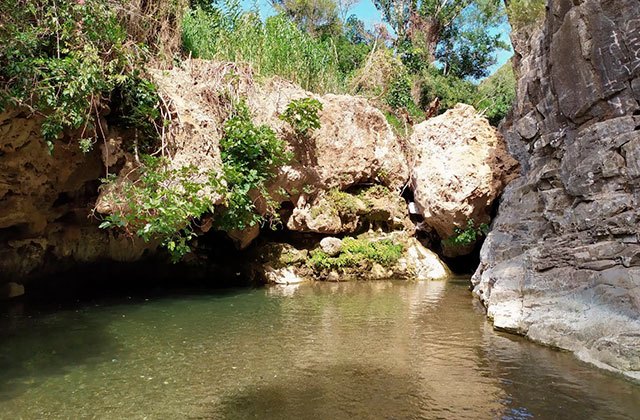
One of Malaga’s most secluded natural pools is probably Poza de los Huevos, located downstream from Barranco Blanco. The pool lies on the River Las Pasadas, in a beautiful landscape between the municipalities of Mijas and Coín.
It forms beside a sulphurous spring whose distinctive smell is the origin of its popular name. A former thermal-bath facility known as Baños del Puerto once stood here, and some remains can still be seen.
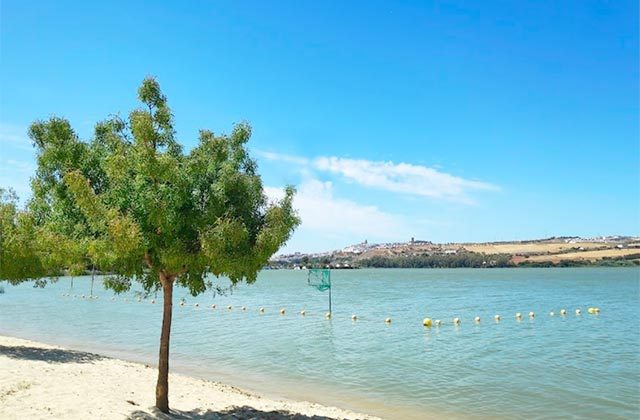
We are all familiar with the beautiful beaches of Cadiz province. Together with its charming towns and excellent seafood-based cuisine, they have made the area one of Andalucia’s leading tourist destinations. However, Cadiz is also home to inland beaches set within idyllic landscapes, including the one beside the town of Arcos de la Frontera.
Arcos de la Frontera is an attractive whitewashed town in the Sierra de Cadiz, surrounded by a beautiful natural landscape of rolling countryside and hills. Among its most interesting landmarks are Arcos Castle, which has been declared an Asset of Cultural Interest, the Mayorazgo Palace and the Peña de Arcos, a spectacular viewpoint designated as a Natural Monument.
Close to the town lies the Arcos Reservoir, which has been declared a Natural Site and a Special Protection Area for Birds. The reservoir has a designated bathing area and is also popular with fishing enthusiasts.
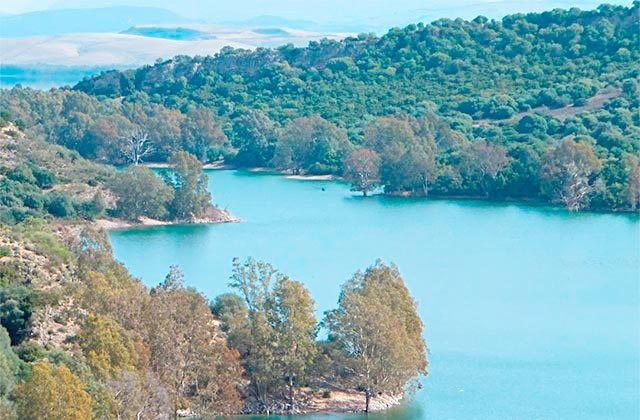
In the province of Cadiz, you will find another attractive inland beach in Bornos, on the reservoir of the same name, which is fed by the River Guadalete.
Bornos is located in the Sierra de Cadiz and has a rich historical heritage. It has been declared a Historic-Artistic Site, and a walk through its picturesque, steep streets reveals landmarks such as the Monastery of Santa María del Rosario, the Castle-Palace of Los Ribera, the Fontanar Tower and the Colegio de la Sangre, a beautiful 16th-century building.
Its natural heritage is equally impressive. The Bornos Reservoir has been declared a Natural Site and a Special Protection Area for Birds. It has also hosted the historic Festival del Lago, a rock music event that first took place in 1980.
The reservoir has a designated bathing area and is also popular with anglers. The town lies beside its shores, making it easy to combine a visit to the reservoir with a walk around the municipality.
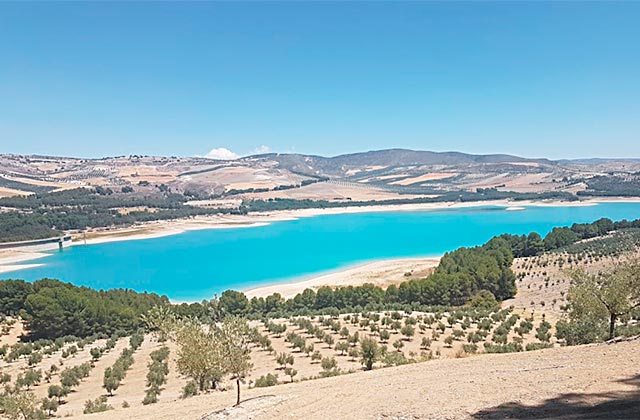
This reservoir lies in a beautiful setting in the Alhama district. Near the town of Arenas del Rey, you will find one of Granada’s inland beaches on the shores of the Los Bermejales Reservoir.
The reservoir is fed by the River Cacín and is one of the area’s main natural attractions. It has an inland bathing area, while several recreational activities are available in the surrounding area.
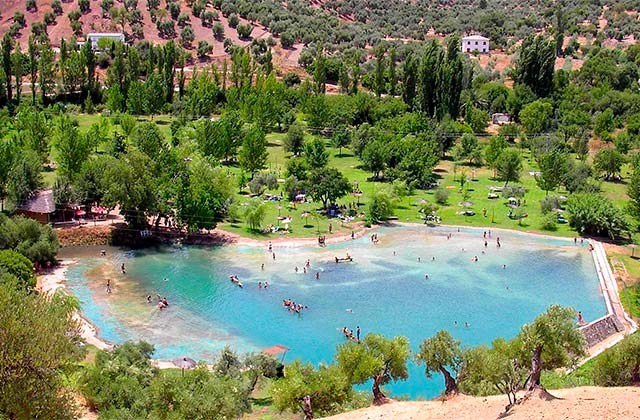
Playita de Arroyomolinos is an inland beach on the outskirts of the beautiful town of Zahara de la Sierra, a peaceful municipality in the north-east of Cadiz province.
Zahara de la Sierra lies amid the beautiful landscapes of the Sierra de Cadiz and forms part of the Sierra de Grazalema Natural Park. Its whitewashed houses spread across the slopes of the Sierra del Jaral, between the Guadalete and Bocaleones rivers.
Despite its small size, the town has an impressive architectural heritage, including its castle of Arab origin, its Nasrid settlement and its main church. Its natural heritage is equally remarkable, with nearby attractions such as Garganta Verde.
Close to the town lies Playita de Arroyomolinos, set at the foot of the Sierra de Monte Prieto. This artificial beach was created by making use of the river that flows through a large recreational area. It is one of the most popular places in the Sierra de Cadiz for spending a summer’s day with the family.
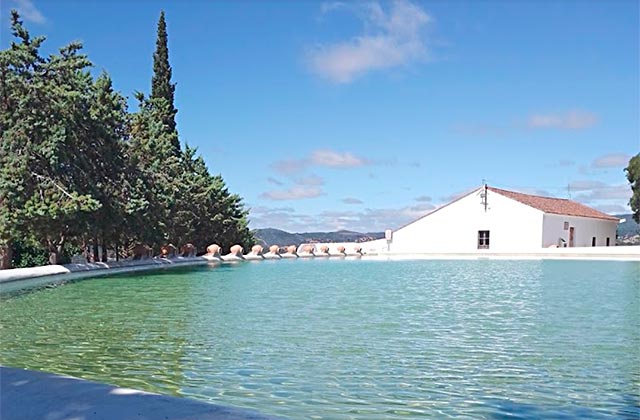
In the heart of the Sierra de Aracena y Picos de Aroche Natural Park, Cañaveral de León offers a very unusual alternative to the beach. In the centre of the village lies La Laguna, a large spring-fed pool traditionally used to irrigate the surrounding vegetable gardens.
La Laguna forms part of El Ruedo and the La Laguna hydraulic complex, which has been declared an Asset of Cultural Interest under the category of a Site of Ethnological Interest. During the summer months, it has also become one of the best-known attractions in the Huelva mountains.
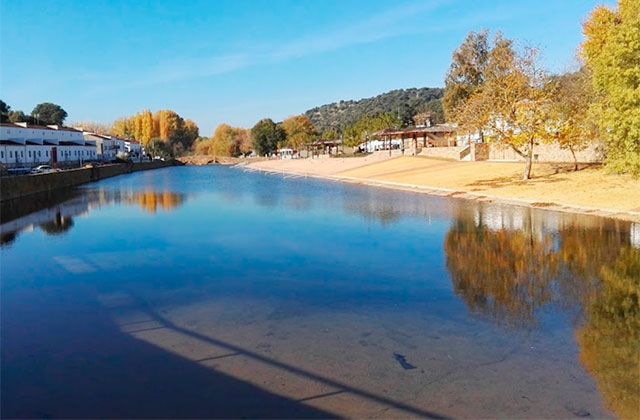
This beach is located in the town of San Nicolás del Puerto, in the heart of the Sierra Morena de Sevilla Natural Park. Its water comes from the Rivera del Huéznar, and it is the designated bathing area in this natural setting.
Around 2 kilometres from the town, the same river forms several waterfalls and pools surrounded by abundant vegetation. Known as the Cascadas del Huéznar, they have been declared a Natural Monument.
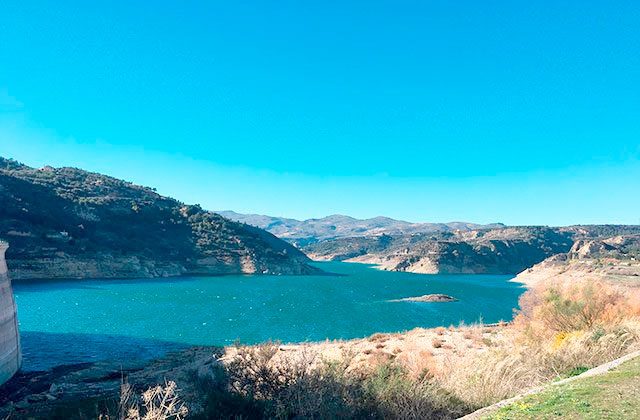
In the distance rise the snow-capped peaks of Sierra Nevada. To the east lies the entrance to Granada’s Alpujarras, while in the foreground is the Béznar Reservoir, set in the heart of the Lecrín Valley.
Near the village of Béznar is a large recreational area managed by the Valle de Lecrín Water Sports Centre, where visitors can enjoy activities such as kayaking, pedal boating, paddleboarding and windsurfing.
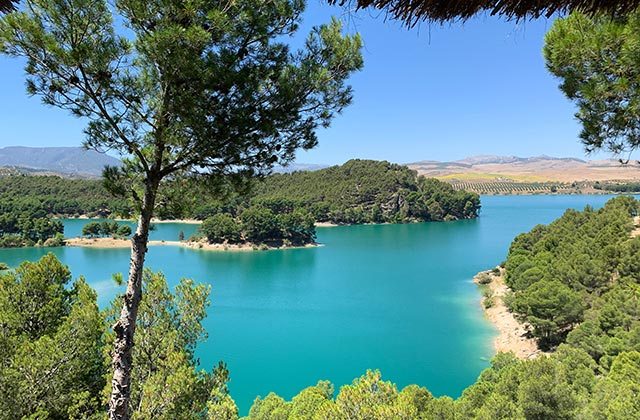
Very close to El Chorro and the Desfiladero de los Gaitanes lies the Guadalhorce reservoir complex. The officially registered bathing area is located at the Conde de Guadalhorce Reservoir, within the municipality of Ardales, surrounded by pine forests and spectacular scenery. The Caminito del Rey and numerous hiking and climbing routes can also be found nearby.
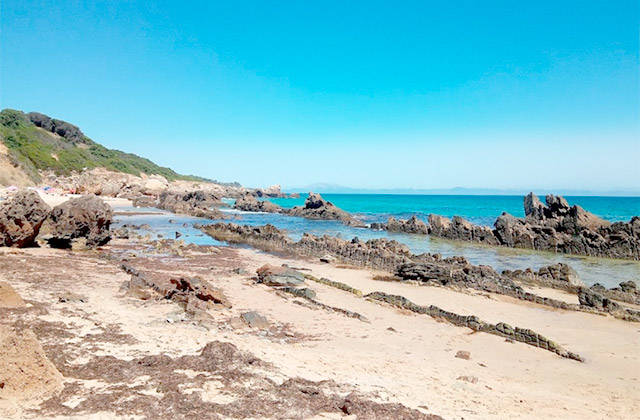
Bolonia is renowned for its fine sandy beach, crystal-clear water, impressive dune and the archaeological site of Baelo Claudia. At the south-eastern end of the beach, natural seawater pools form among the rocks. These are also known as the Baños de Bolonia. They can be reached on foot along the beach or by following a small path above the cliffs.
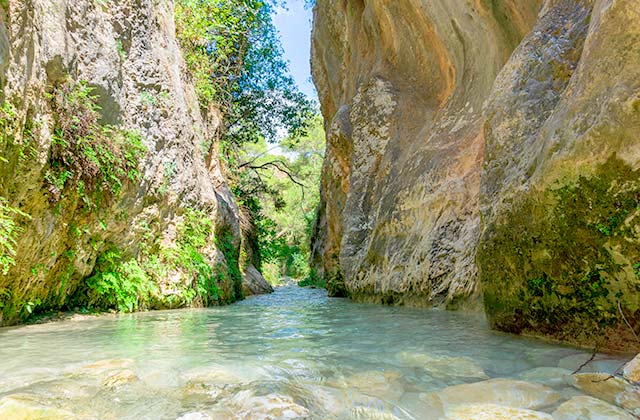
Nature lovers will be familiar with the River Chíllar near Nerja, where the water has carved out narrow gorges, pools and small waterfalls. Los Cahorros is one of its best-known sections, with rock walls so close together that in some places you can almost touch both sides with your arms outstretched.
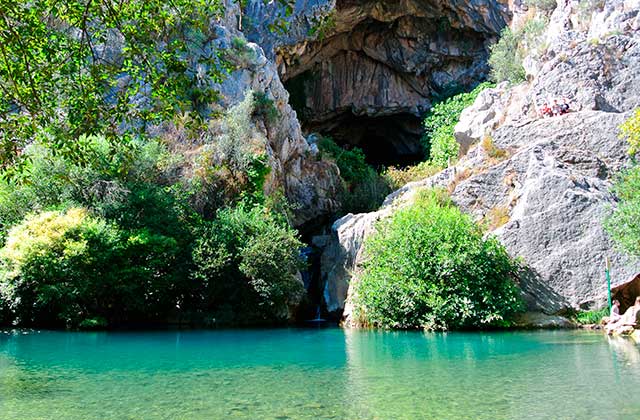
Benaoján is an idyllic village located very close to Ronda. At the entrance to Cueva del Gato, the River Gaduares forms a large pool of cold, clear water. It lies in a beautiful natural setting surrounded by vegetation and steep rock walls.

Balsa de Cela is a thermal spring located on the boundary between the municipalities of Tíjola and Lúcar. Its water rises naturally and remains at a temperature of between 22°C and 24°C throughout the year.
The site has been adapted to make entering the water easier, and its depth ranges from around 50 centimetres to 2 metres.
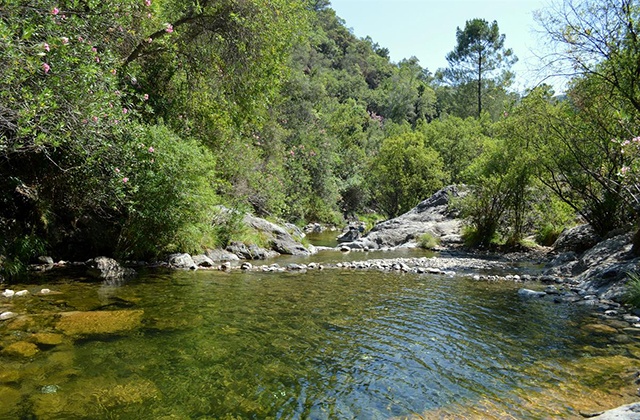
This natural pool lies in the River Verde valley, along the Istán–Charco del Canalón walking route. Here, the river forms a gorge, several pools and a waterfall beside the small channel that crosses the riverbed. It is a beautiful landscape surrounded by rock and vegetation.
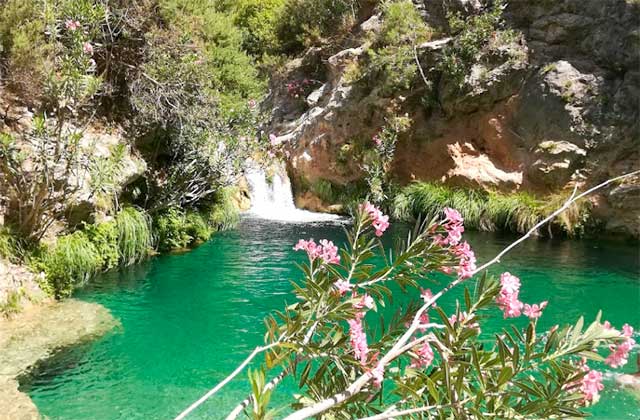
Las Chorreras is a particularly picturesque spot on the River Verde, reached by descending the Barranco de los Chortales. A waterfall plunges into a large natural pool surrounded by limestone walls.
The area is one of the best-known sections of the river for canyoning, thanks to its karst formations and rich natural environment.
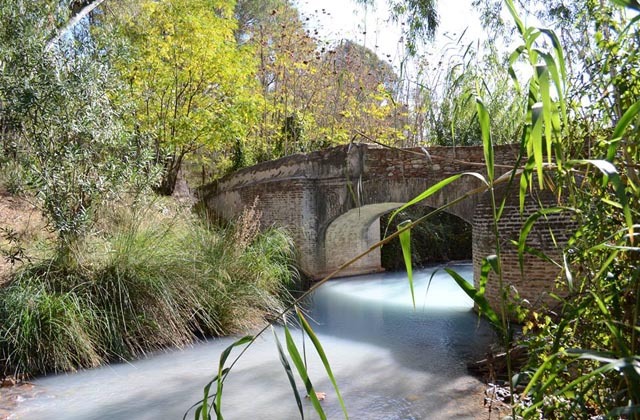
At the confluence of the Utrera and Los Molinos streams lie the Baños de la Hedionda, a sulphurous spring whose use has been documented since the late Middle Ages.
Construction of the present building began in the 17th century, and the site became popular as a bathing destination during the 18th and 19th centuries. Several outdoor pools can be found beside the recreational area.
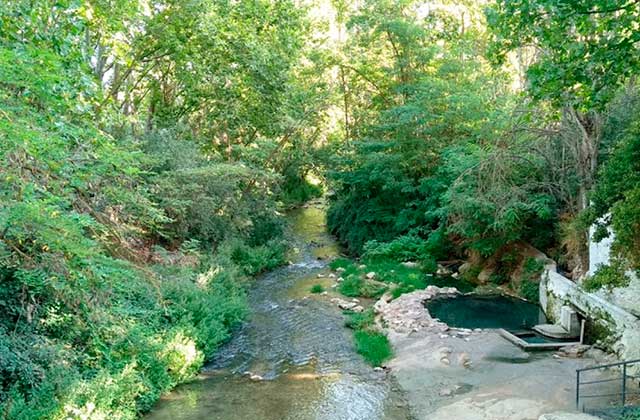
A number of well-known thermal pools can be found beside the river in Alhama de Granada. These small pools are fed by a natural spring, and their temperature varies depending on how close they are to the point where the water emerges.
The area can become quite busy, particularly during the middle of the day.


Andalucia is a region of extraordinary natural richness, and its natural pools are genuine treasures. We hope you have enjoyed this guide to some of the most spectacular and that it inspires you to visit one of them.
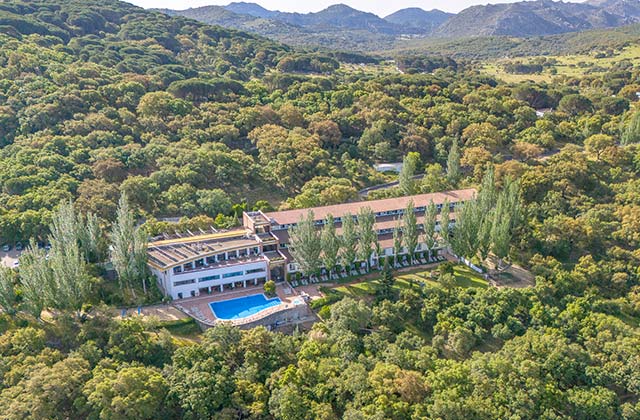
Hotel Fuerte Grazalema
The best accommodation option if you are looking for peace and quiet and the chance to enjoy nature at one of these natural pools is without a doubt Fuerte Hoteles. The chain has establishments where you can enjoy the amenities and the best that each part of Andalusia has to offer. With over 60 years’ experience, they offer the best guarantee for dedicating your time to pure relaxation and enjoying a natural setting. Conil, Grazalema, El Rompido or Torrox are excellent bases for planning day trips and discovering some of Andalucia’s most remarkable natural landscapes.










Great read! I was looking for some around the Malaga area so thanks for the tips.